OEM Eye Cream Development: What the Factory Actually Controls
Once development starts, some variables belong to the brand and some belong to the factory, and mixing them up is what makes a timeline slip. The client site publishes ODM at 4–8 weeks on an existing formula and OEM at 3–6 months with development, which is a wide spread. It also publishes a 0.12% defect rate, ±0.2 ml filling accuracy and 100% weight verification. This article separates the variables a factory controls from the ones a brand should keep.
Key takeaways
- A pilot that reuses a proven base moves in four to eight weeks; a fresh development is a three-to-six-month project with testing inside it.
- The factory publishes a 0.12% defect rate and ±0.2 ml filling accuracy.
- Every unit passes 100% weight verification before it leaves the line.
- The plant covers 30,000 m² and runs 35 automated production lines.
Who owns which variable
A development project has a small number of moving parts, and each one has an owner. The brief, the target user and the market claim belong to the brand. The formula structure, the filling parameters and the quality checks belong to the factory. A project runs smoothly when both sides know which list is theirs.
The confusion usually appears around testing. A brand may treat a stability window as something it waits for, while the factory treats it as work it schedules. Naming the owner of each variable at the start removes that gap. It also explains why one project finishes inside its window while a similar one drifts.
The development flow the factory runs
The client site describes a sequence for eye cream: concept discussion, formula selection and customisation, packaging matching and sample testing, stability and compatibility evaluation, and mass production preparation. That is the spine of the project, and each stage hands something to the next.
The sequence matters because the stages are not interchangeable. A packaging decision made before the formula is settled can force a redesign, and a stability window opened before the sample is final measures the wrong thing. The factory controls the order here; the brand controls what it hands over at the top of each stage so the next one can start clean. A brand that wants to compare formats during that flow can review the eye cream product page.
What the factory controls on the filling line
Some variables are measured rather than discussed. The client site publishes a 0.12% defect rate, a filling accuracy of ±0.2 ml, and 100% weight verification. Read together, they describe a line that checks every unit by weight rather than sampling a batch and hoping.
The plant behind those figures is a 30,000 m² factory running 35 automated production lines. For an eye cream, filling accuracy is not a small detail: the dose is tiny, so a small absolute error is a large relative one. A ±0.2 ml tolerance on a small fill is the difference between a pack that feels consistent and one that runs out early.
The two published windows: ODM and OEM
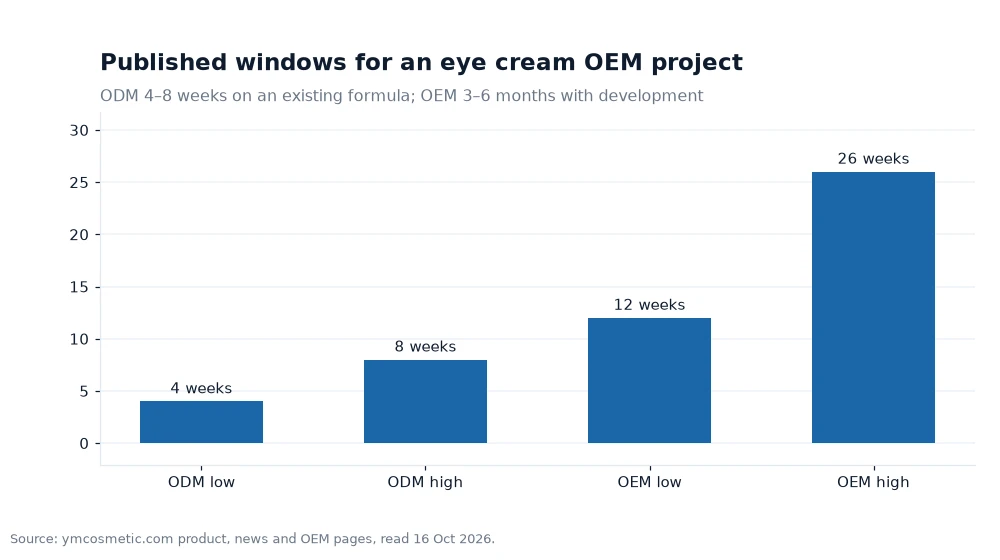
The client site separates the two routes clearly. ODM uses an existing formula and runs 4–8 weeks. OEM includes research, testing and production and runs 3–6 months. The same page notes that stability and compatibility test reports take 3–6 months, which is why the OEM window is not simply a longer version of the ODM one.
Read in weeks, the ODM window is 4–8 and the OEM window is 12–26. The brand's decision is not about which window is better; it is about whether the brief can be met from the library of more than 10,000 mature formulas or needs something built. A dedicated OEM eye cream route sits inside the wider OEM/ODM service, with a laboratory team of more than 70 people grouped by category.
| Route | Published window | In weeks |
|---|---|---|
| ODM low | 4 weeks | 4 weeks |
| ODM high | 8 weeks | 8 weeks |
| OEM low | 3 months | 12 weeks |
| OEM high | 6 months | 26 weeks |
Worked example: setting a launch date from the window
Suppose a brand books a retail slot 20 weeks out. On the ODM route, the published window is 4–8 weeks, so even the slow end leaves 20 − 8 = 12 weeks of buffer. On the OEM route, the window is 12–26 weeks. At the fast end it fits with 20 − 12 = 8 weeks to spare, but at the slow end it overruns by 26 − 20 = 6 weeks.
A second calculation makes the choice sharper. The midpoint of the ODM window is (4 + 8) ÷ 2 = 6 weeks, and the midpoint of the OEM window is (12 + 26) ÷ 2 = 19 weeks. The difference is 19 − 6 = 13 weeks. A brand that needs a formula built should therefore set its retail date at 26 weeks or later, and a brand that can work from an existing formula can plan around a 4-to-8-week window with real margin.
Reading the chart
Four bars show two corridors. The ODM corridor runs from 4 to 8 weeks and the OEM corridor from 12 to 26. The widest single number is 26 weeks, and the narrowest is 4, so the full spread across both routes is 26 − 4 = 22 weeks.
The two numbers to remember are 8 and 12. They are the inner edges of the two corridors, and they show there is no overlap: the slowest ODM project and the fastest OEM project are still 4 weeks apart. That gap is the clearest signal that the route is chosen before the window, not during it.
Where the brand keeps control
Even on an OEM project, some variables stay with the brand. The target customer, the price point, the claim it is willing to defend and the retail date are all brand decisions. The factory can shorten a window but it cannot choose a market or a positioning, and it should not be asked to.
The healthiest split is simple. The brand owns the why and the factory owns the how, with the two meeting at the sample review and again at the stability report. A brand that keeps its own list short and specific gives the factory a clearer target, and a clearer target is the most reliable way to land near the fast end of any published window.
Frequently asked questions
How do the two eye cream routes compare?
Split the two routes: an existing formula fits four to eight weeks, while a developed one spans twelve to twenty-six weeks, with stability and compatibility reports inside that longer block.
What quality figures does the site publish for the factory?
The site publishes a 0.12% defect rate, ±0.2 ml filling accuracy and 100% weight verification, alongside a 30,000 m² factory with 35 automated production lines.
What does the factory control once development starts?
The factory controls the development flow, the formula structure, the filling parameters and the quality checks, while the brand keeps the brief, the target user, the market claim and the retail date.
Working with a partner on the factory side
A brand does not have to hand over the whole project to get the factory's experience. It can keep the brief and the claim, and use the development flow to turn those into a formula that survives its own stability window. Yunmei runs this kind of OEM/ODM work with a laboratory team of more than 70 people and a library of more than 10,000 mature formulas, and a brand can check the day and night eye cream formats while the brief is still open.
Capacity, MOQ and lead-time figures are quoted from the company's published pages, read 16 Oct 2026.[1]